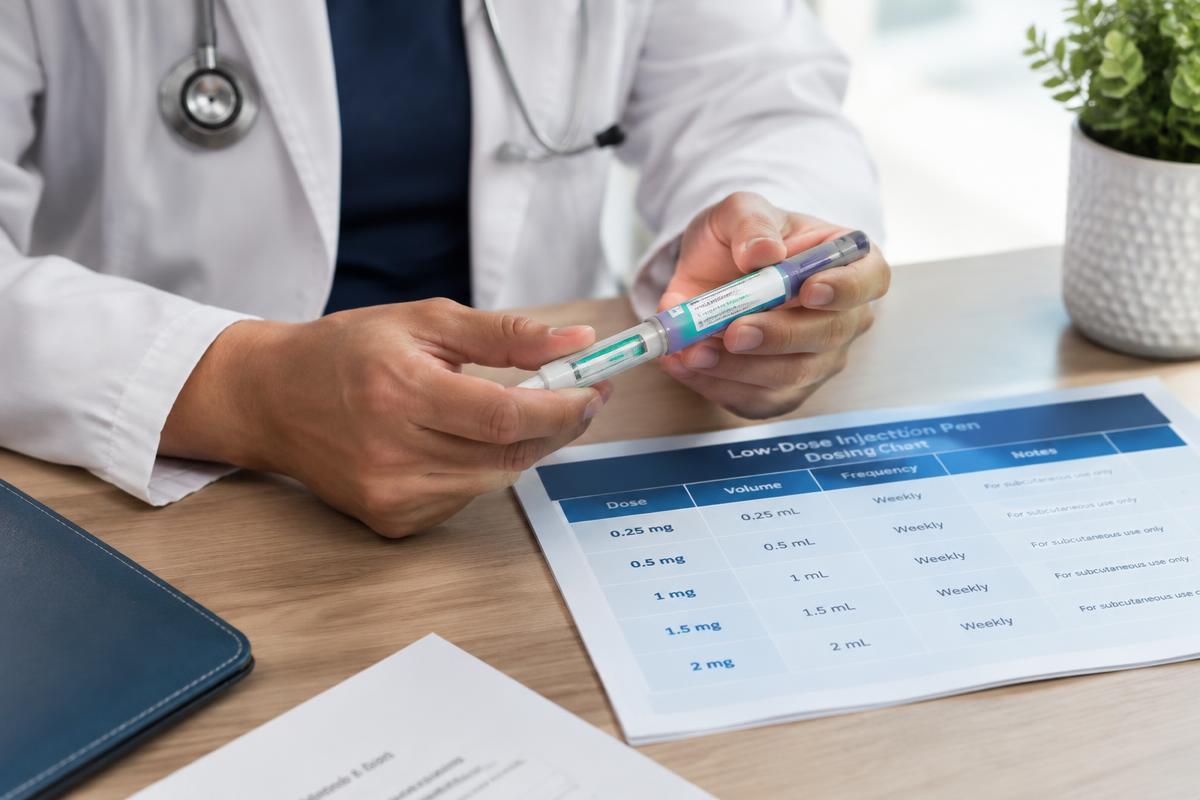
"Microdosing GLP-1" has become a popular phrase on social media, generally referring to using doses of semaglutide or tirzepatide that are lower than the standard starting or maintenance doses studied and approved for weight management or diabetes. Some people describe wanting milder appetite suppression with fewer side effects; others are trying to stretch a limited supply or reduce cost. It is worth separating the marketing language from what is actually known.
This article explains what the term tends to mean, what is and is not supported by evidence, and why dose decisions are best made with a clinician who can evaluate your full health picture rather than a fixed online protocol. At Best Version of You in Stroudsburg, PA, medical weight loss always starts with an individualized evaluation, not a predetermined dose.
What People Mean by "Microdosing"
In GLP-1 discussions, microdosing usually refers to injecting a smaller amount than the lowest FDA-labeled starting dose, often using compounded medication that allows more flexible, non-standard measurements. This is different from the normal dose-titration schedule built into FDA-approved semaglutide and tirzepatide products, where patients start low and increase gradually under medical guidance to reduce side effects while still reaching an effective therapeutic dose over time.
The distinction matters. Standard titration is a studied, approved process. Open-ended microdosing with compounded products, done outside clinical supervision, has not been studied in the same way, and the accuracy and sterility of compounded preparations can vary by source.
What the Evidence Actually Supports
The large clinical trials that led to FDA approval of semaglutide (Wegovy, Ozempic) and tirzepatide (Zepbound, Mounjaro) tested specific dose ranges and titration schedules. Those studies are the basis for what we know about effectiveness and safety at those doses. There is not the same quality of evidence for arbitrary "microdoses" below the lowest studied amount used long-term for weight management. Some patients may do well and lose weight gradually at a lower dose, but it is not a guaranteed or validated strategy, and slower, smaller doses may also mean slower or more limited results.
This does not mean a lower dose is never appropriate. Some patients genuinely do better, with fewer side effects, staying at a dose below the highest label dose, and a clinician may intentionally choose a lower maintenance dose for a specific patient. The difference is that this is a medical decision based on your response and history, not a fixed low-dose plan chosen in advance from an online trend.
Why a Lower Dose Isn't Automatically Safer
A smaller amount of medication is not automatically risk-free. Compounded GLP-1 products, which are commonly used for microdosing protocols sold online, are not FDA-approved and may have variable potency or purity. The FDA has issued public warnings about adverse events linked to compounded semaglutide products, including dosing errors from different concentrations and measurement devices. Any GLP-1 medication, regardless of dose, carries potential side effects and warnings that should be reviewed with a prescriber, including risks related to pancreatitis, gallbladder disease, and thyroid tumors seen in animal studies.
If side effects are your main concern, the right conversation is about titration speed, dose adjustment, and supportive strategies — not necessarily about using an unverified low dose from an unregulated source. Our guide on reducing GLP-1 side effects covers practical, clinician-reviewed strategies.
Why Dosing Should Be Set by a Provider Who Knows You
Appropriate dosing depends on your medical history, current medications, weight-loss goals, tolerance of side effects, and response over time, which is why ongoing monitoring matters. A provider can track your weight trend, labs, and symptoms and adjust the dose up or down as needed — including deliberately keeping you at a lower dose if that is working well for you. This is different from starting with an arbitrary microdose chosen without any clinical evaluation. Comprehensive metabolic lab testing can also help identify whether other factors are affecting your results at any given dose.
If your weight loss has stalled at a particular dose, that is a reasonable thing to discuss rather than a sign you must increase or decrease on your own. Read more in our article on why some patients stop losing weight on a GLP-1.
A Reasonable Way to Approach the Trend
If you have seen "microdosing" discussed online and are curious whether a lower dose could work for you, bring that question directly to your provider rather than sourcing medication independently. A legitimate evaluation will consider your goals, side-effect tolerance, and whether an FDA-approved product with standard titration or a different approach altogether, such as phentermine or peptide therapy, might better fit your needs.
How Microdosing Trends Spread Online
Much of the interest in GLP-1 microdosing has grown through social media posts and online forums where individuals share personal experiences, informal dosing schedules, and sourcing information for compounded products. These accounts can be compelling because they are personal and often enthusiastic, but anecdotes are not the same as clinical evidence, and a strategy that worked for one person online may not translate safely to another person's health situation. Response to any dose of a GLP-1 medication depends on body weight, metabolism, other medications, and underlying health conditions that a social media post cannot account for.
It is also worth noting that some products marketed for "microdosing" are sold directly to consumers without the oversight that comes from a licensed prescriber evaluating your history and monitoring your response. This arrangement shifts a meaningful amount of risk onto the individual, often without the tools to recognize early warning signs of a problem.
Questions to Ask Before Trying Any Non-Standard Dosing Approach
If you are considering a lower-than-standard dose, useful questions include: Is this product FDA-approved or compounded, and from what source? Has my prescriber reviewed my full medical history, including thyroid and pancreatic conditions? What symptoms should prompt me to stop and seek care? How will my response be tracked over time, and by whom? If these questions do not have clear answers, that is a sign the approach may not include the oversight needed for safe use.
A licensed provider can also help you understand the difference between a dose that is simply lower on the standard titration schedule — which is a normal, studied part of starting these medications — and an unconventional microdose outside of established protocols. Conflating the two is a common source of confusion in online discussions.
What a Thoughtful Evaluation Looks Like
At a proper evaluation, your provider will review your weight history, prior attempts at weight management, relevant lab work, current medications, and any personal or family history of thyroid cancer or pancreatitis, since these affect whether a GLP-1 medication is appropriate at any dose. From there, a dosing plan — whether standard titration or a deliberately conservative approach for side-effect sensitivity — can be built around your specific situation rather than an internet trend.
Trusted sources
Learn more from the FDA's consumer updates on compounded semaglutide risks, the NIDDK overview of prescription weight-loss medications, and the Endocrine Society for clinician-reviewed guidance on GLP-1 therapy.
Supervised Care in Stroudsburg and by Telehealth
Simone Blount, FNP-BC, evaluates each patient individually before determining a starting dose, titration pace, or maintenance plan for GLP-1 therapy. Care is available in person in Stroudsburg, PA, and by telehealth in Pennsylvania, New Jersey, New York, and Delaware. See how visits work to get started safely.
Frequently asked questions
- What does "microdosing" a GLP-1 medication mean?
- It generally refers to using doses lower than the standard FDA-labeled starting dose, often with compounded products. This differs from the normal, studied titration schedule used with approved semaglutide and tirzepatide products.
- Is microdosing GLP-1 medications backed by research?
- Large clinical trials studied specific dose ranges and titration schedules for FDA-approved products. There is limited high-quality evidence specifically for arbitrary low-dose protocols used long-term outside of standard titration.
- Is a lower dose automatically safer?
- No. All GLP-1 medications carry potential side effects regardless of dose, and compounded products used for microdosing may have variable purity or dosing accuracy, which introduces its own risks.
- Can my provider intentionally keep me on a lower dose?
- Yes. If you respond well and tolerate side effects at a lower dose, your provider may choose to maintain that dose rather than increasing further. This is an individualized decision based on your response.
- Why do people consider microdosing?
- Reasons include wanting milder side effects, trying to reduce cost, or responding to social media trends. These motivations are understandable, but dosing decisions are safest when made with medical supervision.
- What are the risks of compounded semaglutide used for microdosing?
- The FDA has warned about dosing errors and variable product quality associated with some compounded semaglutide products. Sourcing and supervision matter for safety.
- What should I do if I'm curious about microdosing?
- Discuss it directly with your prescriber, who can evaluate whether a lower dose, standard titration, or a different treatment approach fits your health history and goals.
- Is GLP-1 care available by telehealth?
- Yes. Best Version of You offers in-person visits in Stroudsburg, PA, and telehealth appointments for patients located in Pennsylvania, New Jersey, New York, and Delaware.
Talk it through with Simone
Comprehensive labs, a one-on-one review and a plan built for you — in person in Stroudsburg, PA or by telehealth in PA, NJ, NY and DE.
Book Today